Family Caregiver App in Canada: How to Choose the Right One
Published · 5 min read· Lire en français
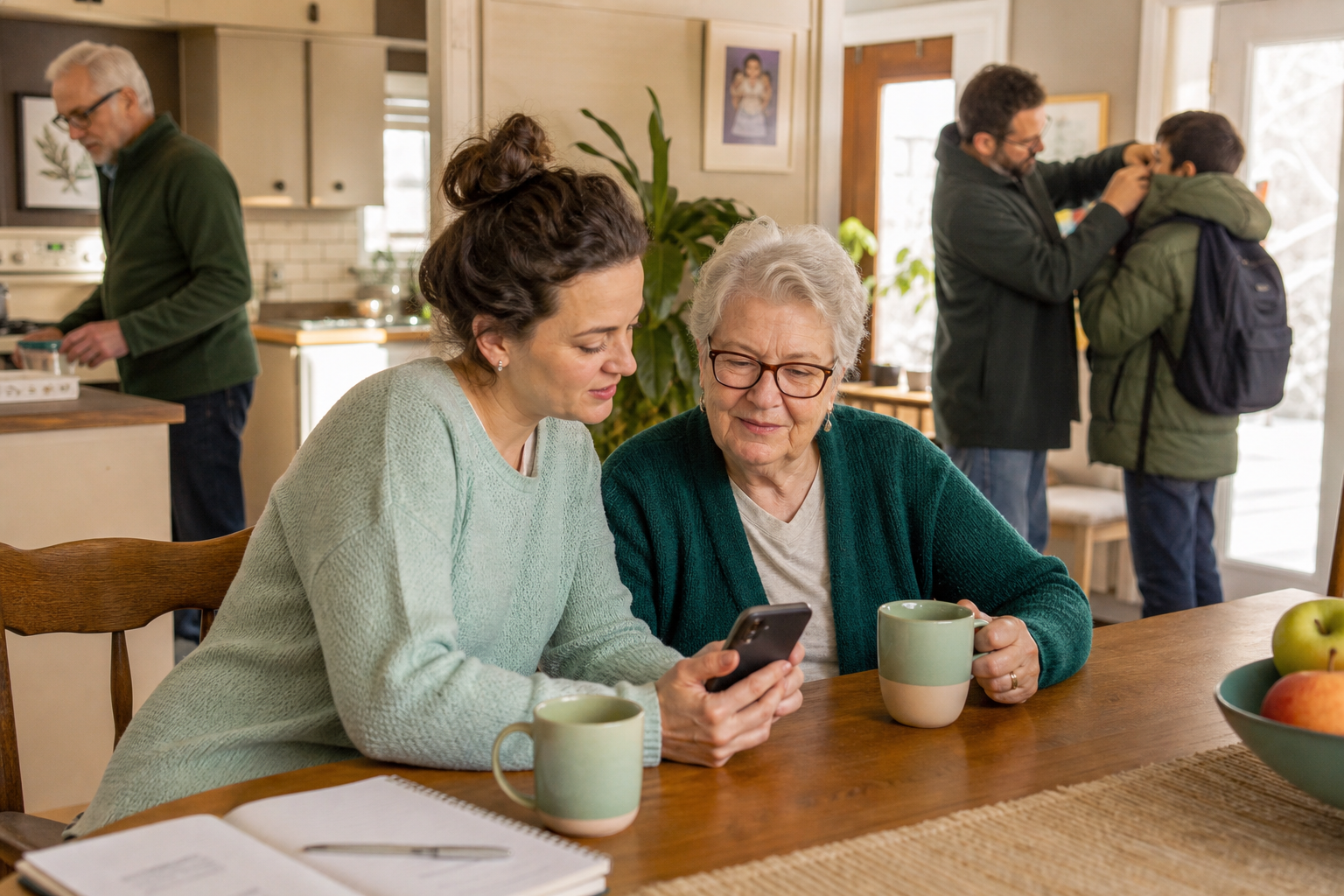
The right family caregiver app lets everyone who helps a loved one see, in real time, who confirmed each dose, who’s driving to which appointment and what happened yesterday. Before you pick one, check four things: confirmation by name, an alert to the family when nobody confirms, separate roles and data hosted in Canada.
What a family caregiver app should actually do
It’s 9:30 a.m. and the family group chat lights up: “Did Mom take her ramipril this morning?” Nobody answers right away. Your brother assumes you stopped by. You assumed he did. That small doubt, repeated every day, is exactly what a family caregiver app should get rid of.
A good app isn’t a pill list. It’s a clear answer to “who did what, and when?” In Soinly, every dose is confirmed with the person’s name and the time, “Confirmed by Sarah at 8:12 a.m.”, and the whole family sees it in real time. A reminder goes out at dose time, a second one 15 minutes later, and if nobody has confirmed after 30 minutes, the family gets an alert.
The same goes for the rest of the week. “Who’s taking Dad to the cardiologist on Thursday?” The person going is listed on the appointment, with reminders. Shared tasks, like a pharmacy pickup or shovelling the driveway, can be claimed in a tap, and the family discussion stays attached to your loved one instead of getting buried between vacation photos.
What to compare before you choose
On paper, caregiver apps look alike. The difference shows up on a Tuesday morning when you need to know whether the dose was given. Here are the questions worth asking each one, based on what we saw on the Canadian market in October 2026. Test it with a real medication and a real appointment: within a week, you’ll know.
Does each confirmation show a name, with a family alert?
A checked box with no name doesn’t tell you who gave the dose. Make sure each confirmation shows the person’s name and the time, that the family sees it right away, and that an alert goes to the others when nobody confirms. Also look at as-needed medications, stock and refill tracking, and how allergies are displayed. In Soinly, they always appear in red.
Does everyone get the right role?
The person running everything doesn’t need the same view as the brother in Halifax who just wants to know how things are going. Look for distinct roles. Soinly has three: primary caregiver, caregiver and read-only. Check the language too: in Soinly, each member picks English or French, which matters in a lot of Canadian families.
Where is the data stored?
Your loved one’s medications, health journal and vital signs are sensitive information. Ask where the servers are and whether the company complies with Law 25, Québec’s privacy law. Soinly hosts its data in Canada and is Law 25 compliant.
Does it help at the doctor’s and in an emergency?
Appointments are short. Appointment preparation with a calculated summary and a PDF report that always includes allergies save you from scrolling through your phone in the exam room. For emergencies, Soinly’s emergency card gathers the essentials on a printable sheet with a QR code.
Yes, caregiving is hard, and stress has real signs
If you’ve wondered whether it’s just you: it isn’t. Caregiving piles practical work on top of worry, often alongside a job and kids. According to the Institut de la statistique du Québec, about a quarter of Quebecers are caregivers (2024-2025 survey), and many don’t even use the word for themselves.
Caregiver stress tends to show up in three ways worth watching:
- Exhaustion that rest doesn’t fix, or sleep that won’t come because you’re running through tomorrow’s list.
- A short fuse, snapping at your loved one, your partner or your siblings over small things.
- Pulling away from friends, hobbies and your own appointments because there’s no room left.
These aren’t diagnoses, and they aren’t character flaws. They’re signals to talk to someone: your own doctor, a caregiver support line, or a friend who will actually listen.
Resentment and caregiver anger: what helps
Caregiver anger is the frustration, sometimes rage, that builds when the load is heavy, unpredictable and unequally shared. It can be aimed at the illness, at your loved one, at siblings who don’t seem to get it, or at yourself. Resentment is its slower cousin: the feeling that you carry everything while someone else gets thanked for a Sunday visit.
Feeling it doesn’t make you a bad caregiver. What tends to help is making the invisible work visible and asking for specific help. An app won’t fix a family dynamic, but it does replace impressions with facts. The activity feed shows who confirmed doses this week, who claimed which task and who’s going to the next appointment. “You’re never here” can become “Can you take the Thursday appointments?” A sibling across the country can read the health journal and reply in the family discussion without waiting for the next phone call.
If you feel you can’t cope, or anger ever makes you fear for your safety or your loved one’s, reach out now. Call 911 in an emergency. For support, call 811 or your provincial health line; in Québec, 811 also offers Info-Social for psychological distress, and L’Appui’s Info-aidant line (1-855-852-7784) is there for caregivers.
Money and recognition for caregivers in Canada
In general, you won’t receive a salary simply for being a family caregiver, but there is financial support, and each program has its own rules and forms:
- Canada caregiver credit: claimed on your federal tax return. The Canada Revenue Agency explains who qualifies.
- EI caregiving benefits: if you need time off work, Service Canada offers family caregiver and compassionate care benefits, with a medical certificate.
- Québec caregiver tax credit: Quebecers claim it on their Québec return, and Revenu Québec sets out the conditions.
Amounts change, so check the official pages each tax season rather than relying on a figure you read once.
What an app doesn’t replace
Soinly is a family organization tool, not a medical device or a health service. It lets the family see who confirmed the dose and when; it never tells anyone what to take, how much or at what time. Those decisions belong to the care team.
- A medication question (a missed dose, a double dose, an unexpected reaction): call your pharmacist.
- A symptom or health concern: 811 or your provincial health line, or your loved one’s doctor.
- A fall, chest pain, sudden confusion: call 911 right away.
The PDF report and shared journal exist so you can walk into those conversations with clear information: what was taken, who confirmed it and what the family noticed.
In an emergency, call 911. For a health question, call your provincial health line (811 in Québec) or talk to your pharmacist. This article is general information, not medical advice.
Learn more
Sources
- Enquête ISQ 2024-2025 : environ le quart des Québécois sont des personnes proches aidantes.statistique.quebec.ca
- L’Appui et la ligne Info-aidant 1 855 852-7784, service d’écoute et de référence pour proches aidants.www.lappui.org
- Crédit d’impôt pour personne aidante du Québec : conditions et demande dans la déclaration.www.revenuquebec.ca
- Prestations d’assurance-emploi pour proches aidants et de compassion, certificat médical requis.www.canada.ca
- Agence du revenu du Canada : crédit canadien pour aidant naturel et admissibilité.www.canada.ca
Written with AI assistance and reviewed by the Soinly team.